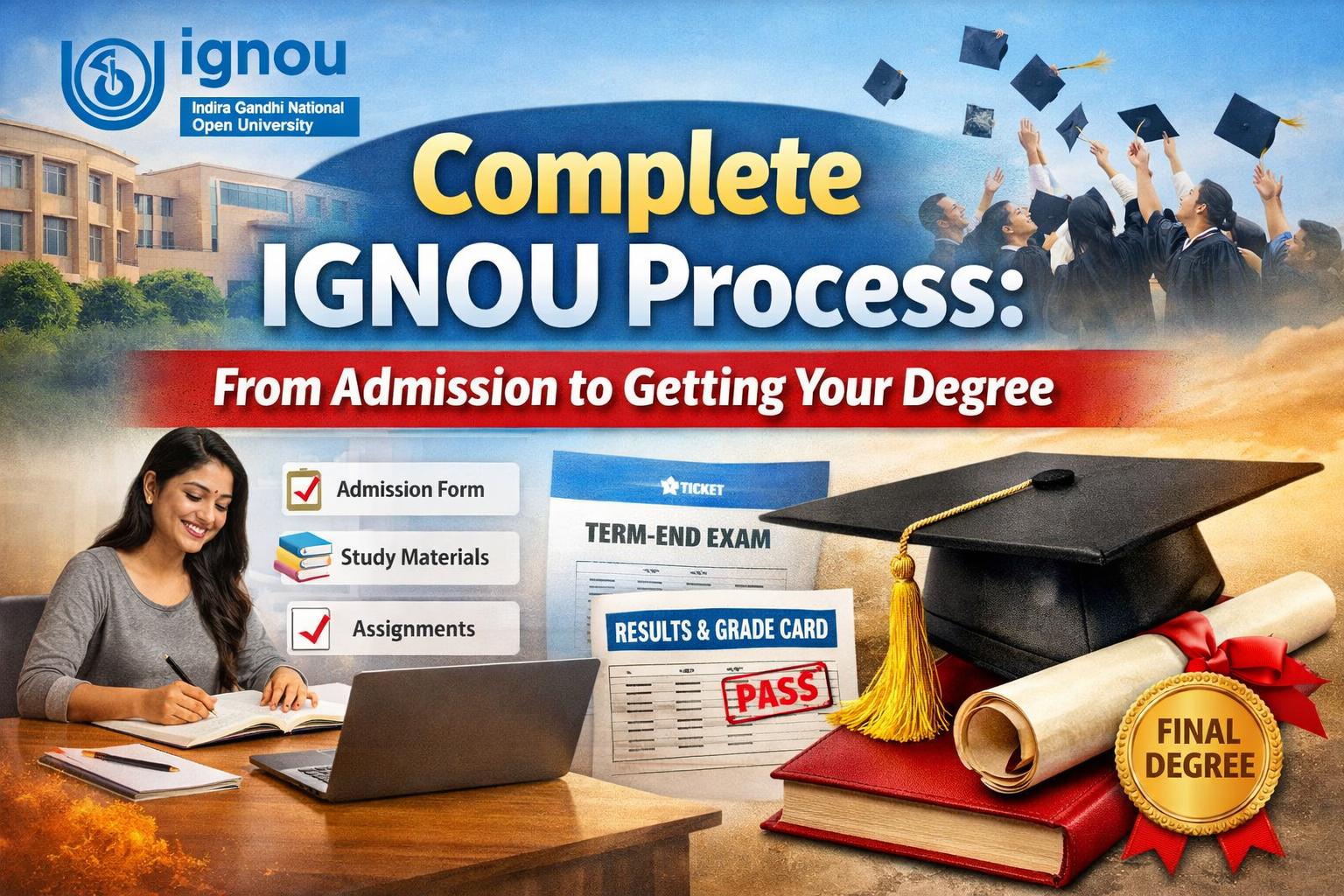
Complete IGNOU Process: From Admission to Getting Your Degree
Many students want to join IGNOU, but they are not fully sure how the full process works. They often know only the first step, which is admission. But after admission, there are many other stages such as study material, assignments, re-registration, exam form, term-end exams, results, and finally the degree.
This is why students sometimes feel confused. They ask questions like these: After admission, what should I do next? When do I submit assignments? Do I need to fill the exam form separately? What is re-registration? When will I get my grade card? How is the final degree issued?
In this article, we will understand the complete IGNOU journey in a simple and practical way. This guide is written for ordinary students, so the explanation is easy to follow from the beginning of admission to the final stage of getting the degree.
Step 1: Choose the Right Programme and Mode
The first step is choosing the right programme. IGNOU offers many certificates, diplomas, undergraduate programmes, postgraduate programmes, and some research options. So before applying, a student should check the programme carefully. The most important things to check are eligibility, duration, fee, medium, and whether the programme is offered in ODL mode or Online mode.
This choice matters because ODL and Online mode are not exactly the same. In ODL mode, printed study material is usually available, although students can choose digital material instead. In Online mode, learning is fully digital and students use the university’s online system. So the student should choose the mode according to personal comfort, internet access, and study style.
Step 2: Understand the Type of Admission
The next thing students should know is that all IGNOU admissions are not of the same type. Most programmes are offered through direct admission, which means if you meet the eligibility conditions, you can apply directly. But some programmes are merit-based, and some selected programmes are entrance-based.
So students should not assume that every course follows the same process. For some programmes, the process is simple. For others, there may be a separate prospectus, merit list, or entrance test. That is why checking the official programme page before applying is always important.
Step 3: Register on the Admission Portal
Once the student selects the programme, the next step is online registration. IGNOU has separate portals for ODL programmes and Online programmes. The student first creates a user ID and password, then logs in and fills the admission form.
During this step, the student has to enter personal details, academic details, category details if applicable, and upload the required scanned documents. After that, the student previews the form and makes the fee payment through the available online methods. Once the form is submitted, there is usually no need to send a printed copy to the Regional Centre for regular online admission cases.
Step 4: Wait for Admission Confirmation
After submitting the form, the student should not assume that everything is finished immediately. The application goes through verification. IGNOU allows students to track the progress of admission, and once the admission is confirmed, a message is sent to the registered mobile number and email address.
This stage is important because if there is any problem or discrepancy in the form, the student may be asked to correct it within a given time. If the issue is not corrected, the form can be rejected. So after applying, students should keep checking their email, mobile messages, and portal status properly.
Step 5: Get Student Access After Admission
After admission is confirmed, the student becomes part of the IGNOU system more fully. This is the stage where the student starts using the student portal, downloads the identity card, and begins following programme-related updates. The student portal becomes important because many future steps depend on it.
The identity card is not just a formal document. It is important later at the time of examinations too. IGNOU clearly states that students appearing in term-end exams must carry the hall ticket along with a valid student ID card. So students should download and keep it safely from the beginning.
Step 6: Receive or Access Study Material
Once admission is done, actual study begins. This is the stage where the student receives or accesses study material. In ODL mode, printed material may be sent unless the student has chosen the soft-copy option. IGNOU also allows students to choose digital study material at the time of admission, and this option currently gives a fee concession in many cases.
Apart from printed books, students can also use eGyankosh and other digital academic resources. This is helpful because it allows learning from phone, tablet, or computer. So even if printed material takes time, students can usually begin preparation through digital resources and downloaded assignments.
Step 7: Attend Counselling or Academic Support Where Needed
IGNOU is flexible, but it does not mean students have no support. Depending on the programme and mode, learners may receive academic counselling, induction guidance, practical support, or web-enabled learning support. This helps students understand how to study the course properly.
Students should stay in touch with their Regional Centre, Learner Support Centre, and official updates. Many students make the mistake of taking admission and then staying inactive. IGNOU works well for serious learners, but the student must stay connected to the process.
Step 8: Download and Submit Assignments
This is one of the most important parts of the IGNOU journey. Students must download the assignments for their current session and complete them carefully. Assignments are not optional for most learners. They are a compulsory part of the academic process.
Many students focus only on exams, but that is a mistake. IGNOU uses a multi-layer evaluation system, and assignments are part of continuous evaluation. In many programmes, a student has to submit assignment responses before appearing in the term-end examination. So assignment work should be treated seriously from the start.
Step 9: Re-Register for the Next Semester or Year
For semester-based or year-based programmes, one very important step comes after the first session: re-registration. Many students think that once they take admission, the university will automatically move them to the next semester or year. But that is not how it works.
Re-registration means registering for the next semester or next academic year of the same programme. IGNOU advises students to submit re-registration online according to schedule, even if they have not appeared in the exam yet or have not passed some courses. This is a very important step in staying on track for timely completion of the programme.
Step 10: Fill the Term-End Exam Form
Another point that confuses many students is the exam form. IGNOU students do not simply appear in exams automatically. For every term-end exam session, the student has to fill the examination form separately. This is done for each exam cycle, usually for June or December.
Before a student can appear in the term-end exam, certain conditions should be fulfilled. The course registration should be valid, the required assignments should have been submitted, the minimum time requirement should be completed, and the examination fee should be paid. So filling the exam form is not just a routine step. It is an eligibility-linked step.
Step 11: Download Hall Ticket and Appear in the Exam
IGNOU uploads hall tickets online before the term-end exams. Students have to download the hall ticket themselves from the official system. Generally, the hall ticket is uploaded a few days before the exam starts, so students should keep checking the website during that time.
On the exam day, the student should carry the hall ticket and the valid IGNOU student ID card. Without a proper identity card, entry into the examination centre may not be allowed. This is why keeping the ID card safe from the admission stage itself is important.
Step 12: Complete Practicals and Project Work, If Your Programme Has Them
Not every IGNOU programme ends with only theory exams. Some programmes also include practicals, project work, dissertation, viva, workshops, or similar academic components. Students in such programmes must complete those parts as well.
This is important because only passing theory papers may not be enough for programme completion. If your programme includes project or practical components, you must finish them properly and follow the official instructions for submission, evaluation, and related fees where applicable.
Step 13: Check Results and Grade Card
After the exams and other evaluations are completed, students should check their results and grade card on the official IGNOU result pages. This stage is very important because it helps the student confirm whether all courses have been completed properly or whether any course still remains incomplete.
The grade card is especially useful because it gives a clearer academic picture. It helps students track assignment marks, exam performance, and completion status. If there is any mismatch, missing update, or issue, students should not ignore it. They should raise the issue through the proper IGNOU channels.
Step 14: Complete All Credits and Programme Requirements
Getting the final degree does not happen just because a student stayed enrolled for a few years. The student must successfully complete all required courses, credits, assignments, exams, and other academic components of the programme. Only then is the student treated as having completed the programme successfully.
This is why students should keep checking their course completion status carefully. Sometimes students pass most papers but miss one assignment, one practical, or one project requirement. In such cases, the degree process may not move forward until all requirements are completed.
Step 15: Get Provisional Certificate and Final Degree
After successful completion of the programme, IGNOU issues the academic completion documents through its evaluation and convocation system. This usually includes the grade card and provisional certificate first, followed by the final degree, diploma, or certificate through the convocation-related process.
In simple words, the provisional certificate shows that the programme has been completed successfully, while the final degree is the formal award document. Students should keep checking the official convocation notifications and portal updates for the final degree process.
Step 16: Register for Convocation When Notified
The final degree is linked with convocation. IGNOU runs a convocation process and students may need to register online when the university opens the degree delivery or convocation registration window. This is the last major stage in the full IGNOU journey.
Some students attend convocation physically, while others are mainly concerned with receiving the final degree document. The important thing is to follow the official notification carefully and complete the required registration within time whenever the university announces it.
What If There Is Any Problem During the Process?
Sometimes students face issues such as admission discrepancy, missing study material, assignment marks not updated, hall ticket problems, result mismatch, or degree-related delay. In such cases, the student should not panic, but should also not stay silent.
IGNOU provides official support channels for these matters, including Regional Centres, the Student Service Centre, result and convocation contacts, and the iGRAM grievance system. If students use the proper channel and keep their records safely, most issues become easier to handle.
Final Thoughts
The complete IGNOU process is not difficult, but it does require attention. Admission is only the beginning. After that, the student must stay active with study material, assignments, re-registration, exam form, term-end exams, results, and final degree updates.
If a student understands the process step by step and follows official schedules carefully, IGNOU becomes much easier to manage. In simple words, success in IGNOU is not only about taking admission. It is about staying regular until the degree is finally in your hands.