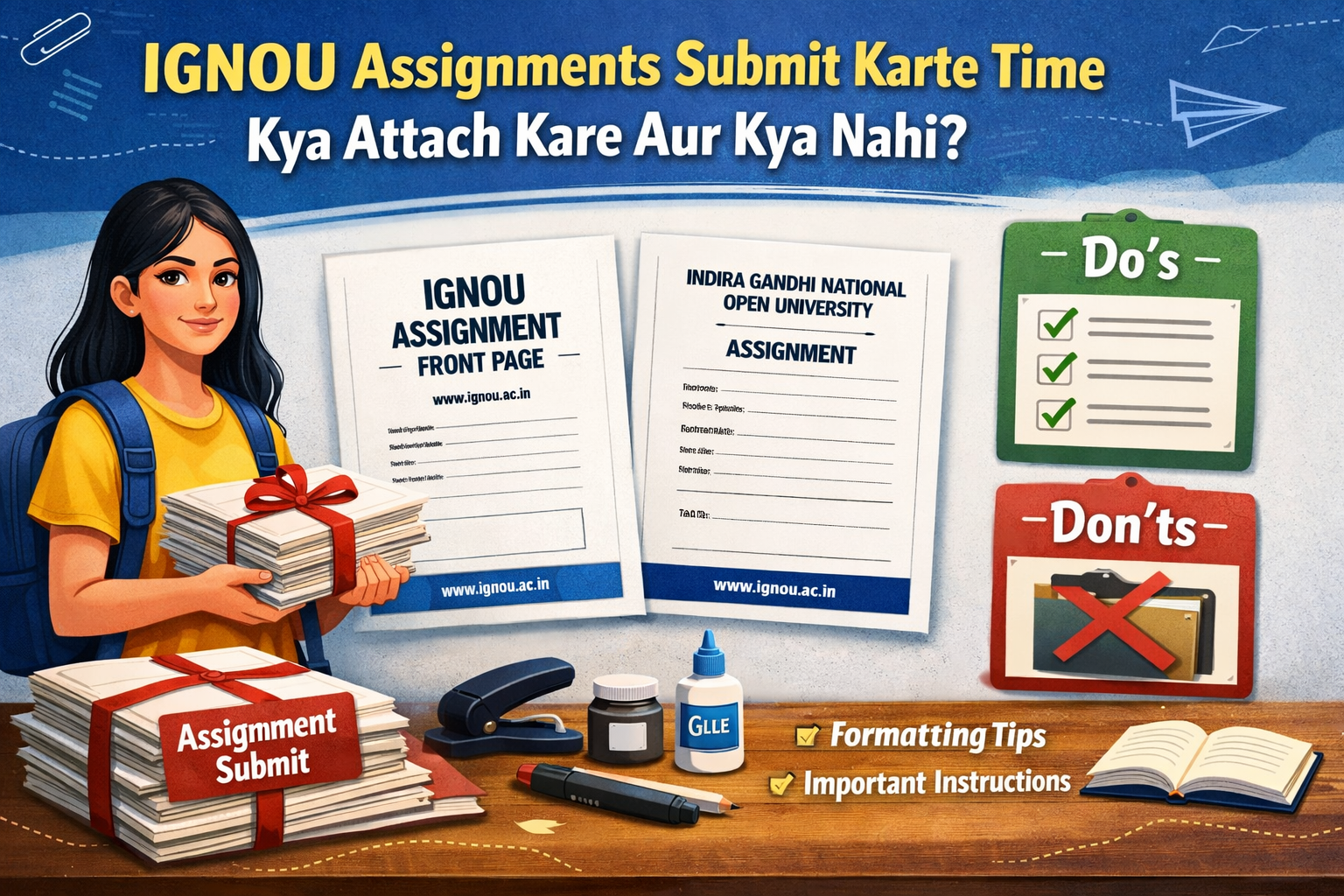
IGNOU Assignment Attachments and Front Page Format: What to Attach, What Not to Attach
Many IGNOU students prepare the answers properly, but still face trouble at the time of submission. In most cases, the problem is not the answer itself. The real issue is wrong formatting, incomplete front page details, wrong attachment, unnecessary extra documents, or poor page arrangement.
That is why students should understand one simple thing: IGNOU assignment submission is not only about writing answers. It is also about submitting the assignment in the correct format. If the format is wrong, marks can get delayed, the assignment may be returned, or the evaluation process may become confusing.
In this article, you will understand what to attach, what not to attach, how the front page should look, and what formatting points you should follow before submitting your IGNOU assignment.
What You Usually Need to Attach
In most normal IGNOU assignment cases, the main things you submit are your handwritten answer sheets and a properly prepared front page or cover page with the required student details. This front page is very important because it helps the centre and evaluator identify your assignment correctly.
In some programme-specific booklets, IGNOU also tells students to attach a copy of the TMA or assignment paper along with the completed answer sheets. This means one extra rule is possible in some courses. So students should not assume that every course follows exactly the same attachment system.
A safe practical rule is this: always attach the proper front page, and then check whether your own booklet also asks for a copy of the assignment questions or any other extra sheet.
What You Usually Do Not Need to Attach
Students often make the mistake of adding unnecessary documents just to feel extra safe. In general, IGNOU assignment booklets do not normally ask students to attach things like Aadhaar copy, passport photo, school marksheet, fee receipt, or random admission papers with every regular assignment submission.
So students should not create a bulky file with unrelated documents unless their own Study Centre or Regional Centre has officially asked for them in a special notice. Too many unnecessary papers can create confusion instead of solving problems.
Also, do not attach typed answer sheets where handwritten submission is required. And do not submit loose mixed pages without proper order.
How the Front Page Should Look
The front page should be clean, clear, and complete. In many current IGNOU assignment booklets, the basic version includes details such as enrolment number, name, full address, course title, assignment number, study centre, and date. In some other booklets, a more detailed format is used with additional fields such as cycle of admission, programme code, assignment code, regional centre code, and contact number.
This means there is not always one single front-page design for every course. The safest choice is to follow the exact sample shown in your own assignment booklet. If your booklet shows a detailed sample, use that detailed sample. If your booklet shows a shorter sample, use that one.
Below are two sample front-page visuals based on current official IGNOU formats. These are useful for blog readers because they help students understand the structure quickly.
Sample Front Page 1: Basic Format
Use this style where your booklet follows the common short format with basic student and course details.
Sample Front Page 2: Detailed Format
Use this style where your booklet asks for more detailed programme and admission information.
Recommended Front Page Details
For most students, these are the most important fields to check: name, enrolment number, full address, date or date of submission, course title, assignment number or assignment code, course code, and study centre. In some cases, programme title, programme code, regional centre code, cycle of admission, and contact number may also be required.
Do not leave blanks carelessly. A front page with missing details can slow down the evaluation process. Write clearly and neatly so that the centre can easily read your information.
Formatting Rules Students Should Follow
Formatting matters more than many students think. In some current IGNOU booklets, the paper size mentioned is foolscap. In others, A4 paper is mentioned. So once again, follow your own booklet first. Do not blindly copy one rule from another course.
Your answers should normally be handwritten, not typed or printed, unless your programme has a specific special rule. Write the relevant question number with each answer. Arrange the pages in proper order. Keep each course assignment separate. Staple or tag the pages properly so that they do not get mixed.
A neat and well-formatted assignment looks serious and is easier to evaluate. A careless presentation can create unnecessary trouble.
What to Attach in Special Cases
There are some special cases where extra sheets may be needed. For example, some programme-specific instructions say students should attach a copy of the TMA or assignment paper along with the completed response. In some centre-specific online submission instructions, extra pages like identity-card copy or assessment sheet have also been asked.
But students should remember one key point: these are not universal for all IGNOU learners. So do not add such extra pages unless your own programme booklet or your own Study Centre or Regional Centre notice clearly asks for them.
What Not to Do
Do not submit typed answers where handwritten submission is required. Do not attach random personal documents without need. Do not mix multiple courses in one continuous unlabelled bundle. Do not leave the front page incomplete. Do not forget the course code or assignment number. Do not send assignments to the wrong centre or wrong email address.
And one more important thing: do not submit your only copy and forget everything. Keep a photocopy or scanned copy of the full assignment safely with you.
Should You Attach a Receipt or Proof?
You do not attach the receipt inside the assignment bundle itself. But you should definitely keep proof of submission with yourself. If you submit physically, try to collect a receipt or acknowledgement from the Study Centre. If you submit online, keep screenshots or confirmation emails. If you submit by post, keep tracking proof.
This proof can become very important later if your assignment marks do not update on time.
A Simple Ready-to-Use Checklist
Before submitting your assignment, check these points one by one. Are the answers handwritten? Is the correct assignment used for the correct session? Is the front page complete? Are course code and assignment number correct? Are the pages arranged properly? Is the right attachment added if your booklet asks for it? Did you avoid unnecessary documents? Did you keep a copy and submission proof? If yes, then your submission is in a much safer position.
FAQ: Common Student Questions
1. Is there one fixed IGNOU front page for every programme?
No. Many programmes follow a common basic structure, but some booklets use a more detailed format. Always follow your own booklet first.
2. Do I need to attach Aadhaar card or photo with every assignment?
Normally, no. Do not attach such documents unless your own centre or official notice specifically asks for them.
3. Do I need to attach the assignment question paper too?
Sometimes yes, sometimes no. Some programme-specific booklets clearly ask for a copy of the TMA to be attached. So check your own booklet.
4. Can I use typed front page and handwritten answers?
The safer option is to keep the full assignment in a clean, student-friendly format accepted by your centre. Where booklets say handwritten assignments only, students should avoid turning the submission into a typed packet unless officially allowed.
5. Should all course assignments be placed in one file?
Keep each course clearly separate. Do not write or tie all assignments in one confusing continuous bundle.
6. What is the safest way to avoid problems later?
Follow your booklet exactly, keep the front page complete, avoid unnecessary attachments, and save proof of submission.
Final Thoughts
Most IGNOU assignment problems do not happen because students cannot write the answers. They happen because the formatting, attachment, or front page is wrong. That is why students should be careful about small details.
In simple words, keep the assignment clean, handwritten, properly labelled, correctly attached, and correctly arranged. Follow your own booklet more than general internet advice. That is the safest and smartest approach.